"What is it you want, old man?"
The Broken Trough §
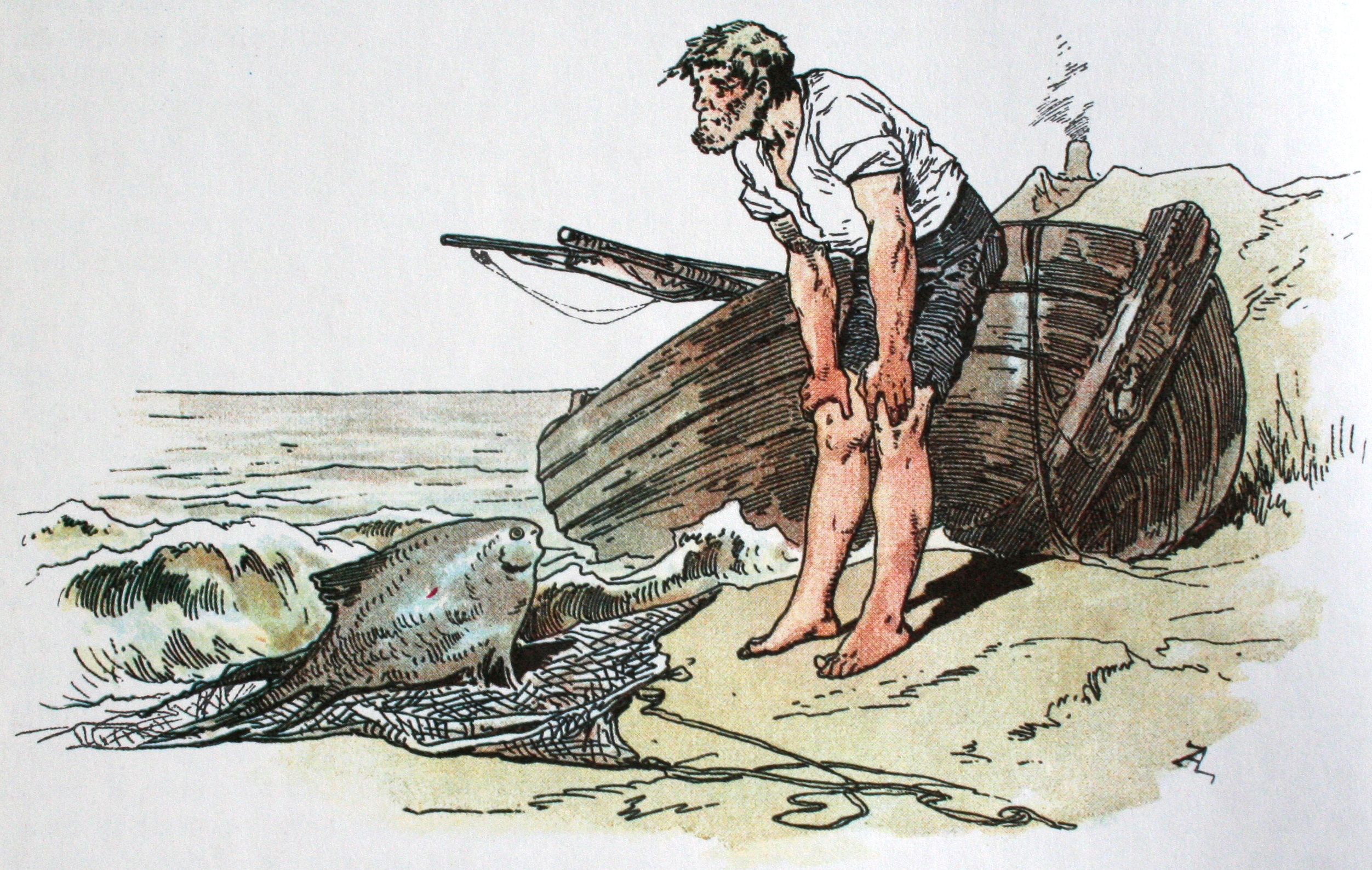
The old woman in Pushkin's tale had a perfect executor: instant, tireless, unlimited budget. A trough, a cottage, noble rank, a whole kingdom, all delivered on time and without a single error. It ended, as we remember, at a broken trough.
The fish never once erred. The intention did. Each granted wish bred the next, none of them would have made her happy, and none, on a closer look, was truly her own: what she wanted was never the cottage or the crown. She wanted the bowing.
Genie stories were never about genies.
Now the fish comes by subscription, twenty dollars a month. Code, prose, analysis: everything that only yesterday was a profession and a point of pride grows cheaper with every release, not from any drop in quality, but because it stopped being scarce. And everyone is asking the same question, with more anxiety in it than curiosity: what in me stays valuable?
The answer, I think, is simpler than we make it. What stays is whatever can't be delegated in principle. There is exactly one such thing, and it can be trained.
The Ladder of Delegation §
The first answer that comes to mind is managing the agents. True, but only for a while: agents already manage agents, and every rung you retreat to ("fine, I'll just supervise") is automated a year later.
The ladder does end, though, not in an activity but at a point: the source of preferences. No one can want on your behalf. By definition.
Ronald Coase and the prosthetic will
Outside, in the economy, falling coordination costs shrink the firm. Ronald Coase explained this back in 1937, in "The Nature of the Firm": a firm exists as long as coordinating inside it stays cheaper than the market, so the optimal organization contracts toward one person with a tree of agents beneath them. Inside, in the psyche, the same thing happens: an agent that knows your state, your calendar and your priorities, and settles the small decisions for you, is doing the work of executive control, the very thing we usually call the will.
In both places the bottleneck is identical: not computation, not skill, but clarity about your own wanting.
If the agent is a prosthetic will, where do I end? The line runs by role, not by task. To the adviser you can hand almost everything: counting, remembering, showing you the odds. The act of deciding itself you keep wherever the decision shapes you, trains a faculty you'd hate to lose, or plays out on hostile ground.
the principal's burden
The principal's seat, the act of deciding itself, is worth holding wherever at least one of three holds:
- the decision is constitutive: a conversation about your salary isn't "computed"; it forms your sense of your own worth, which is the whole point of having it;
- the decision trains a faculty you'd hate to lose: your feel for the right moment for a hard conversation atrophies if the agent always decides;
- the field is hostile, and the channel the advice runs through can be captured: your employer's HR bot will be delighted to tell you when to ask for a raise.
Judgment you can rent; the will you can't. That is exactly why people don't stop mattering to one another. When execution is free, what we buy from each other is calibrated judgment: a critic's taste, a mentor's eye, a doctor's discernment. The economy of doing turns into an economy of trust and taste.
So the last human skill of the AI age is not prompt engineering, and not "managing agents." It is the ability to want at high resolution. Sounds nice. What does it mean?
The Anatomy of Wanting §
We're used to treating a desire as a point: "I want X," end of discussion. It's more useful to see it as a thing with anatomy, with properties you can tell apart and train. I count seven, in three families; the number is a working grid, not scripture.
Richness is how much structure the desire holds. Resolution: how many gradations you tell apart; a designer sees twelve steps between "good enough" and "right," the client sees two. Dimensionality: how many properties you even have an opinion about; a novice picks wine by price, a sommelier holds twenty features and, more to the point, knows which to sacrifice. Horizon: whether the desire reaches the person you'll be in ten years, far enough to change what you do today. Everyone can want "now"; wanting on behalf of your future self is a skill.
Integrity is whether you can trust the desire as a bearing. Coherence: whether your preferences run in circles, or flip with your mood. Groundedness: whether the desire rests on true facts about what will actually satisfy you; the classic case is spending years wanting a promotion that turns out not to make you happy. Authorship: how much of the desire is yours, and how much was quietly imported by advertising, status, someone else's feed. Girard was right: we want what others want, and we almost never notice the swap.
Bandwidth is whether you can get the desire out. One axis here, articulability: inside it may be rich; on the way out it becomes "make it, you know, hit hard."
Of the seven, five bear the load: groundedness, coherence, authorship, dimensionality, horizon. Resolution you can underpay, but it can't do you harm; and articulability AI has already collapsed to near zero: anything stated clearly is now buildable.
why these five
By an axis I mean a property that reads off a single journal on its own and changes what you delegate. The five load-bearing ones pass both tests: a miss on them is the most dangerous kind, amplified by execution rather than merely underfed, and each reads separately from a blind reconciliation. The other two fail both: resolution is bounded above, not below, and articulability has been zeroed out. Both tests unfold below, in the distinction between ordinary and dangerous poverty and in the chapter on measurement. "Seven" itself is a hypothesis about the number of columns, not a fact about the soul; the same journal is free to refute it.
Why the taxonomy? Because AI acts on these axes very differently, and that difference is the whole story.
AI multiplies execution by the spec you hand it. Hence the central distinction of this essay: the poverty of a desire comes in two kinds. Ordinary poverty (low resolution, few dimensions) merely underserves: you get the mediocre. Dangerous poverty, the poverty of integrity, actively harms, because execution amplifies it: an incoherent or ungrounded goal a strong agent optimizes perfectly, then delivers, fast and polite and on time, exactly the thing you didn't really want. Multiply by muddy and you get a great deal of muddy.
Dangerous poverty has a diagnostic sign: the better the execution, the worse the outcome. The old woman at her broken trough is dangerous poverty with an unlimited execution budget.
one example per integrity axis
Groundedness broken. You tell the agent, "make me as productive as possible." It flawlessly clears your calendar: aimless walks, long lunches with friends, "empty" slots. All optimized to zero. And those were exactly what the life you were doing this for was made of. The grounded goal was "a life I won't regret"; the ungrounded proxy, "productivity," is executed brilliantly and leads in precisely the opposite direction. A weak executor would have been safer here: it couldn't have reached the walks.
Coherence broken. Your preferences flip with your mood: Monday you want to drop everything and leave, Tuesday you want stability. This used to cancel itself out: the impulse passed before you could act on it, and slow execution filtered your inconstancy. A fast agent quits your job on Monday, while the impulse is still warm, and freezes the fleeting into the irreversible. With money it's harsher still: inconsistent preferences (A>B>C>A) can be milked in a loop, and a tireless executor will find that loop.
Authorship broken. You want what your feed wants: the body, the house, the career from the picture. The agent delivers it, beautifully and on schedule, and real years have gone into someone else's goal, a swap you'll notice only at the finish line. The amplification here is the most insidious: the same infrastructure that shapes the desire now also fulfills it. The loop closes with no human inside.
AI doesn't so much make us more productive as expose how little we know about our own desires. That ignorance used to be cheap: years of labor stood between a wish and its result, and the wish had time to ripen or fall away on its own. Now minutes stand between them. For the first time in history, not knowing yourself has become expensive.
Measuring What Lies About Itself §
How do you find out where you stand on these axes? Asking yourself won't do: self-report measures the self-portrait, and the self-portrait flatters. You have to judge yourself on evidence, not testimony: on the choices you made, and on your forecasts checked against outcomes. Anyone who has honestly reread a year-old diary knows this better than the psychologists do.
The good news: you don't need seven instruments. One decision journal is enough: every wanting that matters, with its options, the choice, the motives, and a forecast of feeling. After that, time does the work, because the axes are just different ways of rereading the same journal. Reread it blind and you see coherence. Live to the appointed date and you test groundedness. Ask "do I still sign off on this?" and you learn about authorship.
Two things, though, are beyond discipline. You can't honestly re-ask yourself six weeks later: you remember your old answer, and memory obligingly fits the new one to it. And you won't come back to the entry on the appointed day: life gets in the way. Both gaps are closed by a simple tool: it keeps your forecast sealed until you answer afresh, and it comes back for you on its own, right on time.
And one warning, courtesy of Goodhart: the moment a measure becomes a target, it goes bad. No points, no streaks. A compass, not a thermometer.
One objection remains, the deepest. Whose compass am I measuring with? Isn't choosing the method itself an act of will? Shouldn't I trust my own sensations and nothing else? Half of this is right: the decision to measure yourself, the choice of axes, and the final "yes, that's me" are the principal's seat; you can't hand them to a methodology or a tool. But the other half gets the order of reliability backwards. Raw sensation is the most capturable layer of all: it's molded by lost sleep, blood sugar, status anxiety, and yesterday's feed. Method is not the rival of feeling but its lever: a ruler doesn't take away your sense of proportion, it hands you a number to judge. Feeling is the last judge, but a poor witness.
The true picture is Neurath's boat: the ship is rebuilt on the open sea, plank by plank, never putting in to dock; feeling and method correct each other against outcomes. And the fear "have I imported someone else's method?" dissolves under that method's own test: if you can name why you took it and under what condition you'd drop it, the method is yours, wherever it came from. Everything worthwhile came from outside: language, mathematics, values. Authorship is not about the source; it's about adoption.
what psychoanalysis would say
That last line, "authorship is about adoption, not source," Lacan would sign: his ethics is precisely to assume your desire, not to trace its pedigree. But then he'd object to the whole frame. For psychoanalysis, desire is unconscious, insatiable, and foreign from the start: "desire is the desire of the Other." In that light, the three things the journal treats as faults are the very nature of desire. The gap between forecast and fact is not a calibration error but desire's constitution: you always miss, because you never wanted the object, only to keep wanting. Incoherence is not noise but the voice of a split subject: Monday's "drop it all" and Tuesday's "stability" are the conflict that is you. And a blind reconciliation is still the ego rereading its own journal; on this line the truth surfaces not in evidence but in the slip and the transference, in the relation to another.
I don't dismiss the objection; I take it as a boundary. intlog doesn't reach into the unconscious and decodes nothing; it works one floor up, at the layer of revealed preference, and promises not the "real you," only a compass. And where the needle swings into the red (recall the "relationships" row), the tool itself tells you to rent someone else's resolution: a mentor, a therapist. Psychoanalysis doesn't refute the journal; it marks where the journal ends and the couch begins.
intlog: an intention journal §

I put all of this into intlog, a small local utility: one SQLite file, no cloud. An intention has two touches: an entry with a forecast, and a blind reconciliation on the appointed day, where you answer before you see your own prediction.
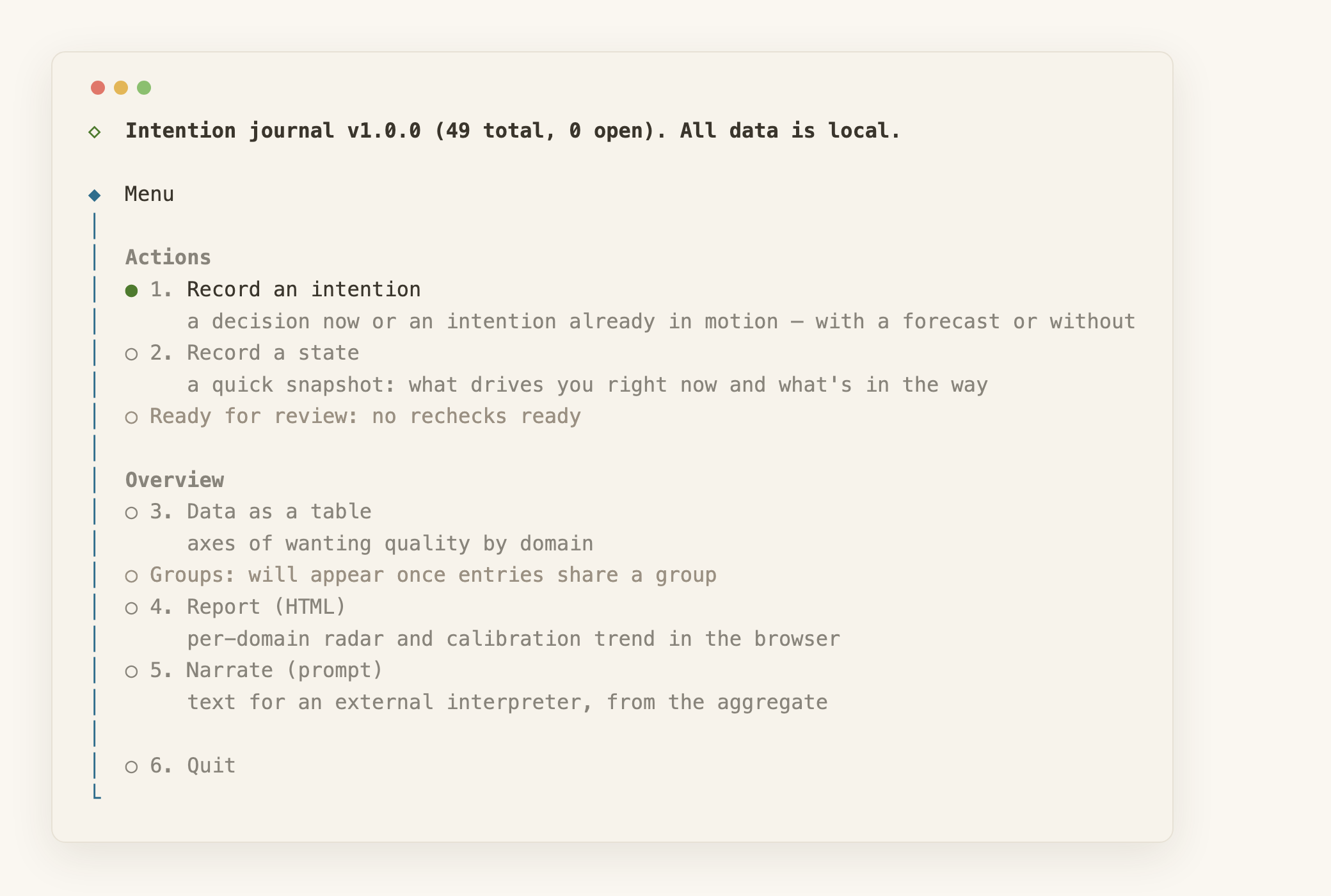
The first touch is the entry, two or three minutes. First the tool asks: would it upset you to be proven wrong in a month? If not, nothing gets written: the journal is worth keeping only while it holds what matters. Then the domain; what you're deciding; the options you actually weighed; what you chose; the motives that tipped the choice. And above all, the forecast of feeling: what you expect, how strong, how long, and why. Reconciliation dates snap to Sunday, so everything ripe waits for you on one morning, inside a single ritual.
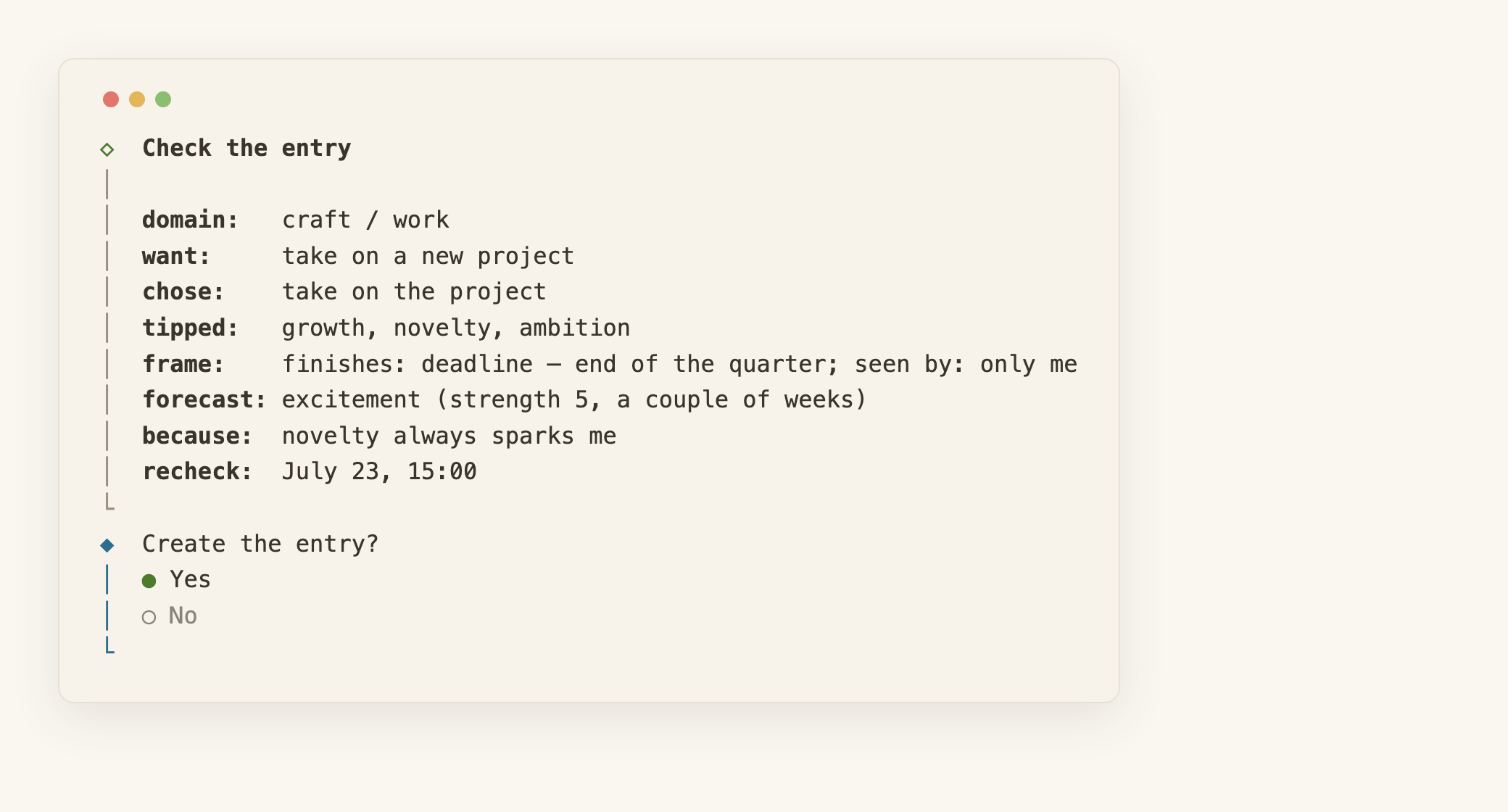
The second touch is the reconciliation, done blind. On the appointed day the journal returns your intention but hides the forecast. First you answer: what you actually felt; whether events unfolded as expected (this separates a surprise from the world from a miss in self-knowledge); whether you'd choose the same again; whether the wanting is still yours. Only then the reveal: forecast beside fact. Did the feeling you expected arrive?
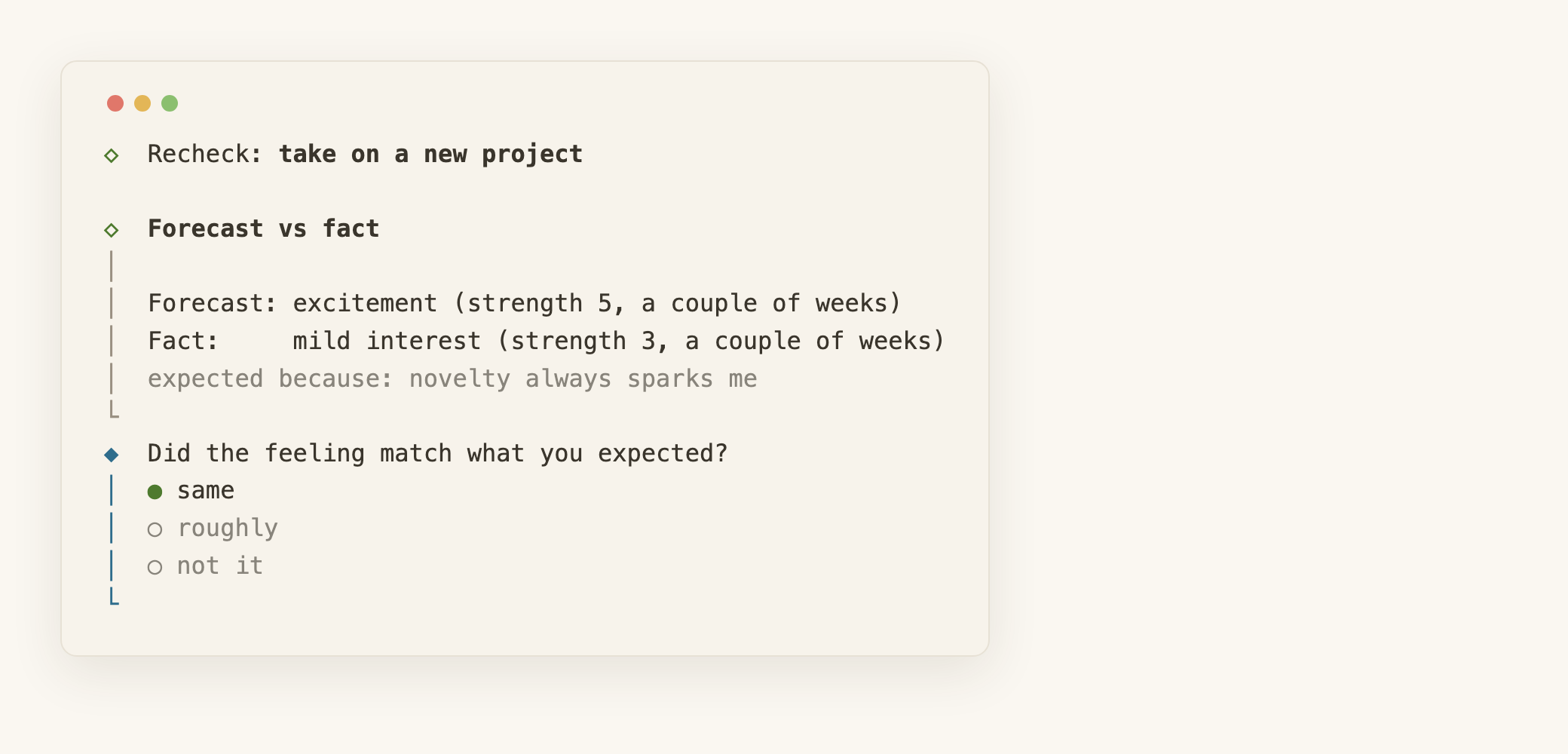
An intention journal is about the most intimate data there is: expectations about work, relationships, the body. Hence a local file. There is no reason to lie to it.
the limits of accuracy
At reconciliation you compare the forecast not with the experience itself but with your memory of it; both sides of the comparison are subjective, and memory reconstructs too. The journal measures the consistency of your expectations with your own later assessment. That's more modest than "objective accuracy," but it's the best signal available without sensors on your body.
And it's enough: even if the statistics never become significant, the ritual itself (name the options, name the motives, give a forecast, come back blind) already changes how you decide. Decision journals were recommended by students of the mind long before any AI; all that's been added to the old practice here is the blindness and the inevitability of return.
A Year In §
A year in, the journal holds thirty to sixty closed entries. The picture might look like this:
domain           n   closed  grounded  dimens.  author  no-regret  world
money           14   0.93    0.86      0.62     0.90    0.86       0.90
work            16   1.00    0.55      0.60     0.90    0.75       0.80
relationships    9   0.69    0.41      0.30     1.00    0.44       0.90
body             4   0.57    —         —        —       —          —      · low data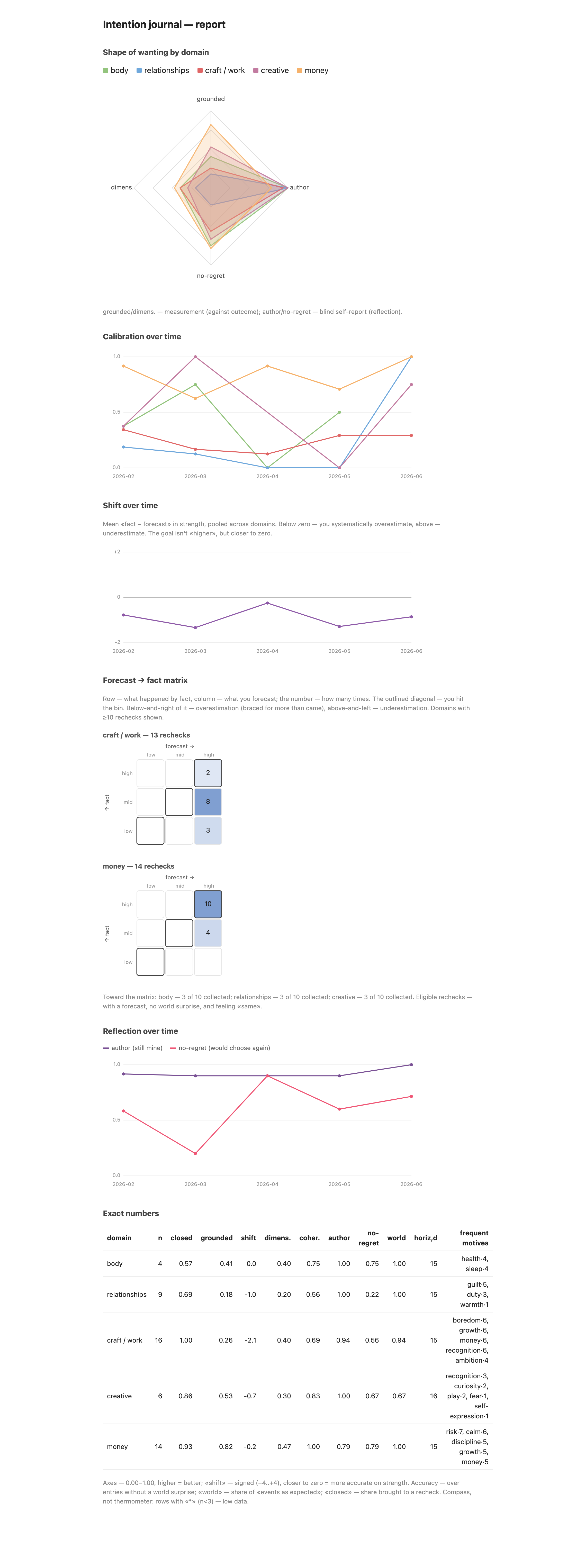
how to read the columns
All the fractions run from 0 to 1; higher is usually better, except n (a count) and world (a reliability context, not a score of you). Everything is computed per domain, because in different areas you predict yourself differently.
- n — how many closed entries accumulated. It's the weight of the row, not a grade: at small n the numbers are noisy and the row dims with a "low data" mark.
- closed — the share of reconciliations completed: closed ÷ (closed + overdue). How many ripe reconciliations you actually went through; we tend to skip precisely the ones we're afraid to answer.
- grounded — the accuracy of the affective forecast: a feeling match × closeness of intensity, averaged over the domain, but only over entries where the world didn't surprise you.
- dimens. — dimensionality: how many motives you even had an opinion about (the count of distinct tags at entry, out of five).
- author — the share of entries where, at blind reconciliation, you answered "yes, this is still my wanting." Reflection, not a check against outcome.
- no-regret — the share of "I'd choose the same again." Also self-report, and tinted by outcome: an unlucky result drags it down even when the decision was right.
- world — the share of entries where events unfolded roughly as you expected. A low "world" is about the unpredictability of the environment, not about you; it tells you how far to trust "grounded" in that domain.
A dash "—" means "nothing to compute": there are still too few closed entries with the needed fields (as in the "body" row).
Money: forecasts accurate, motives rich. This judgment you can trust; delegate execution freely here and spare yourself the double-checks.
Work: a steady bias. Time and again, "the new project will light me up, a five, for months," and in fact a three, gone flat within two weeks. One miss is chance; the twelfth is a trait.
Relationships: decisions on a single motive, accuracy below a coin flip. The red zone: automate nothing here. The opposite: this is where you learn, where you rent someone else's resolution (a mentor, a therapist, an old friend), and where you train dimensionality, naming the third and the fourth motive when your tongue reaches for "gut feeling."
Body: barely more than half the reconciliations closed. This row isn't about the body; it's about avoidance, and it may be the truest needle on the whole compass.
This is the solid ground: not the numbers themselves (they're noisy) but a map of where to trust your wanting, where to train it, where to guard it from capture.
The models will get smarter every six months, in execution. Your work is no longer there. It's in the one place the ladder of delegation can't reach.
Cautious Optimism §
"Know thyself" was carved at Delphi twenty-six centuries ago. Two things are new since then: not knowing yourself has grown expensive, because it is now multiplied by the power of the executors, and the task has finally acquired an everyday tool.
A notebook and three rules will do: write down the decisions that matter, with a forecast of feeling; come back on time and answer before you peek; reread once a season.
I don't know where the models will be in five years. No one does, and anyone claiming otherwise is selling a course. But I do know where I can be in those five years: a little more accurate about what I want. By today's standards that is an almost indecently reliable investment: the stronger the executors, the more a clear client is worth.
The old woman had no pause between her wishes; each new one arrived before she could hear the last one out. We have that pause, brief as a breath, and we have a journal, so as not to lose it.
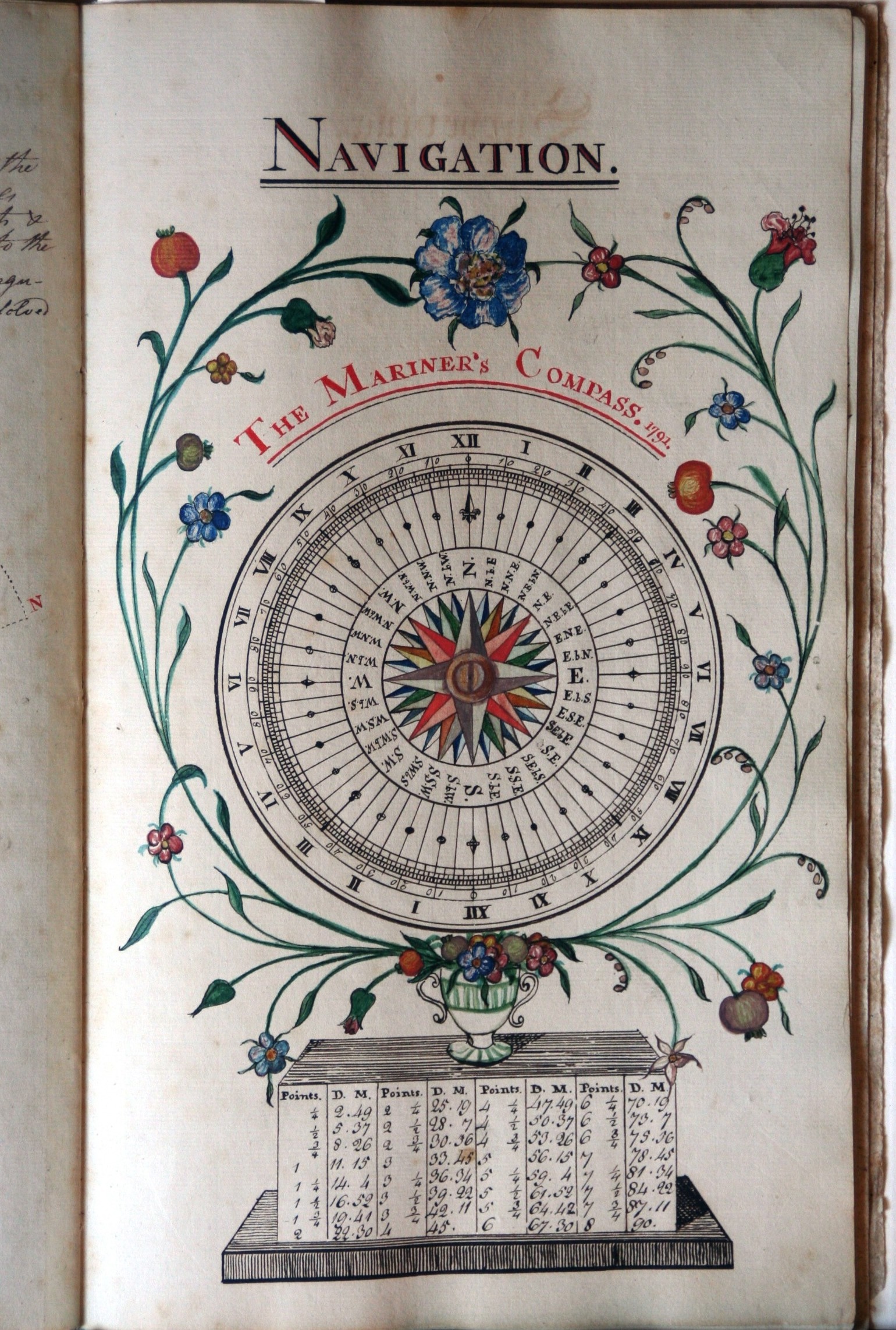
The sea won't calm. But a compass works in a storm too.
In fact, a storm is exactly when you need one.